The Freelancer's Guide to Retirement Planning
Nobody is matching your contributions. Compare Roth IRA, SEP IRA, and Solo 401(k) options for freelancers, with 2026 contribution limits and a practical saving system for variable income.
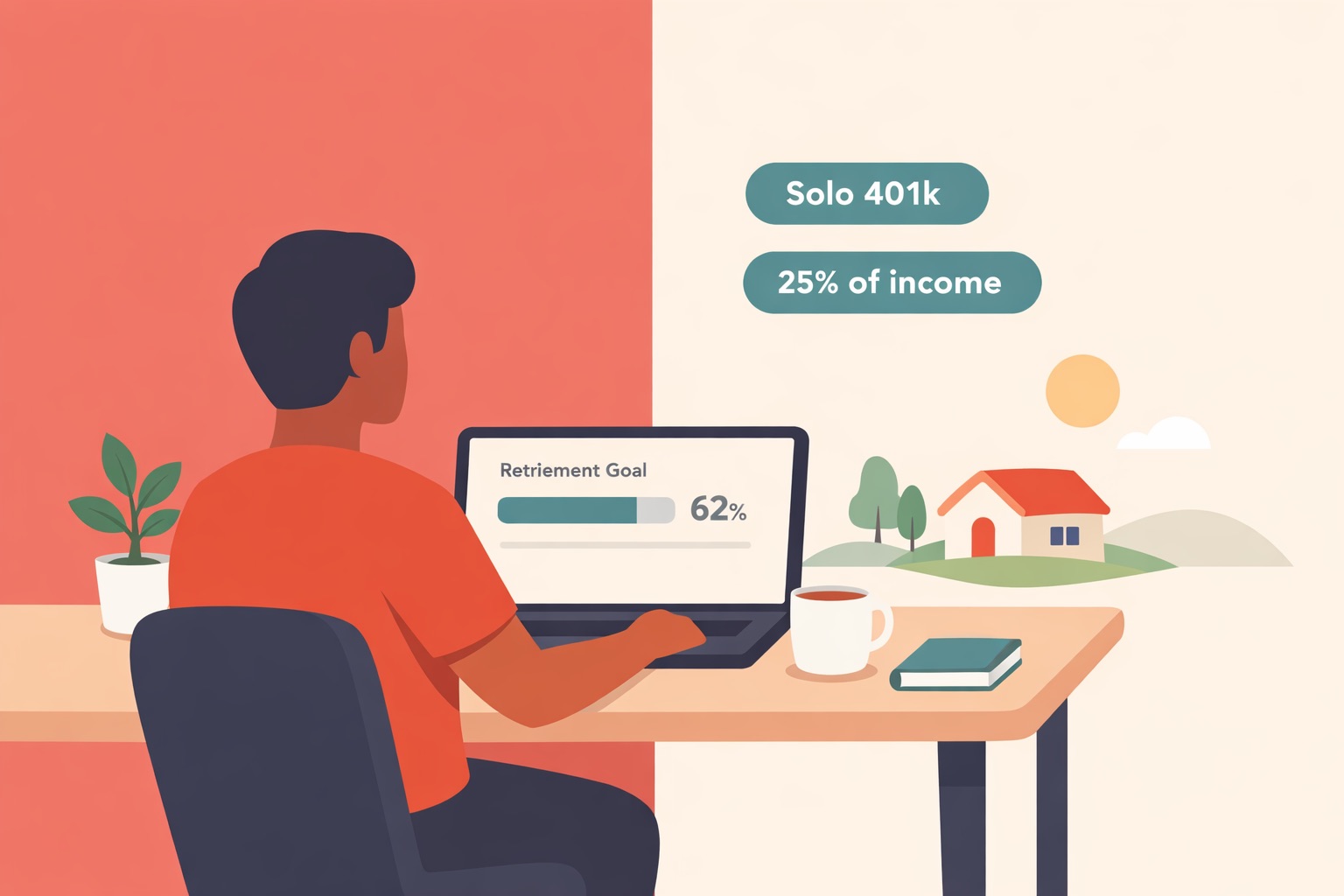
TL;DR: As a freelancer, you have access to three main retirement accounts: the Roth IRA (simplest, best for lower incomes), the SEP IRA (easiest to max out at high income), and the Solo 401(k) (highest contribution limits at moderate income, and the only option with a Roth layer). Nobody is going to match your contributions, so you have to build the habit yourself. The best system is simple: treat a percentage of every client payment as a retirement transfer, not a bonus.
Nobody is matching your contributions. No HR email will remind you to set up your 401(k). There's no pension waiting at the end. That's the deal you accepted when you went freelance, and for most people, it's still worth it. But it also means retirement is entirely your problem to solve.
Most freelancers know this and still do nothing. According to Aviva research from January 2026, only 40% of freelancers are actively saving into any kind of pension or retirement plan. Only 22% have a written retirement plan of any kind. The most common "strategy" among the rest? Keep working.
That's a plan that depends on your health, the market for your skills, and your desire to be coding or designing at 70. It's a fragile plan.
The good news: you actually have better retirement options than most employees. You just have to use them.
Why Freelancers Procrastinate (And Why It's So Expensive)
The usual excuses are real. Income is irregular. Last month was great; this month is slow. You'll sort it out once things stabilize. The problem is that "once things stabilize" is a moving target that most freelancers never actually reach.
But there's a more specific reason freelancers delay: the retirement account decision feels complicated. IRA, Roth IRA, SEP IRA, Solo 401(k), SIMPLE IRA - each has different limits, different rules, different tax treatments. When the choice itself feels overwhelming, the path of least resistance is to postpone.
This section exists to remove that excuse.
The cost of waiting is concrete. If you invest $500 per month starting at age 25, at a 6% average annual return, you'll have roughly $1,000,000 by age 65. Start that same habit at age 35 and you end up with around $502,000. Same monthly contribution. Same return. Half the result. Compound growth is front-loaded in the early years, which is why a decade of delay is so punishing.
Even one year makes a visible difference. Starting is the decision that matters most.
The Options: A Plain-English Comparison
You have four realistic account types as a freelancer. Here's what each one actually means.
Roth IRA
The simplest starting point for most freelancers. You contribute after-tax money, it grows tax-free, and withdrawals in retirement are completely tax-free. No required minimum distributions during your lifetime, so you can let the money compound as long as you want.
Contribution limits for 2026: $7,500 per year ($8,500 if you're 50 or older).
The catch: Roth IRA eligibility phases out at $153,000-$168,000 of modified adjusted gross income for single filers. If you're earning above that range, a "Backdoor Roth" conversion is available but more complex.
Best for: freelancers under $150,000 annual income who want simplicity and tax-free retirement withdrawals.
Traditional IRA
Same contribution limits as the Roth IRA ($7,500 in 2026). The difference: contributions may be tax-deductible, reducing your taxable income today. Withdrawals in retirement are taxed as ordinary income.
For most self-employed freelancers who are not covered by an employer plan, contributions are fully deductible. The choice between traditional and Roth often comes down to whether you expect your tax rate to be higher or lower in retirement than it is now.
Best for: freelancers who need a current-year tax deduction and expect to be in a lower tax bracket in retirement.
SEP IRA (Simplified Employee Pension)
This is the easy option for higher earners. You can contribute up to 25% of your net self-employment income, with a maximum of $72,000 in 2026. No Roth option - all contributions are pre-tax.
The administrative simplicity is a real advantage. There are no annual filing requirements, you can open one at any brokerage in minutes, and you can wait until your tax filing deadline (including extensions) to make contributions for the prior year. This makes it ideal for freelancers with variable income who want to calculate their actual contribution after seeing their full-year earnings.
The limitation: a SEP IRA only allows employer contributions. That means on a $60,000 net income, you can contribute 25%, which is $15,000. With a Solo 401(k), you can contribute the same $15,000 as the employer portion plus up to $24,500 as the employee portion, reaching $39,500 from the same income.
Best for: high earners (above $150,000) who want simplicity and don't need the Roth option.
Solo 401(k)
The most powerful option for most freelancers. Also called the Individual 401(k) or Self-Employed 401(k), it is available to anyone who is self-employed with no full-time W-2 employees (a spouse who works in the business is allowed).
What makes it powerful is the dual contribution structure. You contribute as both the employee and the employer:
- Employee deferral: up to $24,500 in 2026
- Employer contribution: up to 25% of net self-employment income
- Combined maximum: $72,000 in 2026
This dual structure is why the Solo 401(k) dramatically outperforms the SEP IRA at moderate income levels. At $80,000 of net self-employment income:
| Account | Calculation | Max Contribution | |---|---|---| | SEP IRA | 25% of $80,000 | $20,000 | | Solo 401(k) | $24,500 + (25% x $80,000) | $44,500 |
That is a $24,500 difference from the same income - the entire employee deferral layer that the SEP IRA simply does not have.
Additional advantages of the Solo 401(k):
- Roth contributions are available (unlike the SEP IRA)
- Loans are allowed under certain conditions
- Enhanced catch-up contributions for age 60-63: you can contribute up to $83,500 total in 2026
One important rule: the plan must be established by December 31 of the tax year in which you want to begin contributing. You cannot open a Solo 401(k) in April 2027 and retroactively contribute for 2026. Plan ahead.
Best for: freelancers earning $40,000-$150,000 who want to maximize contributions, especially those who want a Roth layer.
Which Account Should You Actually Use?
Here is a direct decision guide by income level:
| Annual net income | Primary choice | Why | |---|---|---| | Under $30,000 | Roth IRA | Simple, tax-free growth is most valuable at lower rates | | $30,000-$60,000 | Roth IRA + Solo 401(k) | Roth for tax-free growth; Solo 401(k) to capture higher limits | | $60,000-$150,000 | Solo 401(k) (Roth or traditional) | Employee deferral layer gives dramatically higher limits than SEP IRA | | Over $150,000 | Solo 401(k) + HSA + Backdoor Roth | Maximize all available vehicles; tax diversification matters here |
Note: generally, you cannot contribute to both a SEP IRA and a Solo 401(k) from the same self-employment income in the same year. You can contribute to a Roth or traditional IRA alongside either, subject to income limits.
SECURE 2.0 Changes That Affect You in 2026
The SECURE 2.0 Act introduced several changes that freelancers using a Solo 401(k) should know about:
Raised contribution limits: The 401(k) employee deferral limit increased to $24,500 in 2026 (from $23,500 in 2025). IRA limits increased to $7,500.
Roth catch-up mandate: Starting in 2026, if you earned more than $145,000 in FICA wages in 2025, your Solo 401(k) catch-up contributions must be made as Roth contributions. This affects high-income freelancers who were previously making pre-tax catch-up contributions.
Super catch-up provision (age 60-63): Workers in this age range can now contribute an additional $11,250 above the standard $24,500 limit, for a total employee deferral of $34,750, plus the employer portion. Total plan limit reaches $83,500.
The practical takeaway: if you are over 50 and running a Solo 401(k), your contribution capacity increased meaningfully in 2026.
The Variable Income Problem (And How to Solve It)
The hardest part of retirement saving as a freelancer is not picking the right account. It is maintaining consistent contributions when your monthly income swings from $3,000 to $15,000.
The traditional "save a fixed amount per month" system breaks down quickly with freelance cash flow. A better system is percentage-based:
The invoice-to-retirement pipeline:
- Every time a client payment lands in your business account, transfer a fixed percentage immediately.
- Use 15% as a starting point. If you are starting after 35 or have lost years to catch up, use 20%.
- Transfer it to a separate account or directly to your brokerage before you "see" it as available.
- At year-end, calculate your total allowable contribution for your chosen account and make any top-up needed.
This system works because it aligns with how freelancers actually receive money. You are not fighting against a calendar; you are building a rule tied to events that already happen - client payments. If you need help organizing how freelancers manage their bank accounts, setting up separate accounts is the foundation for this pipeline.
A few guidelines:
- Before you automate retirement saving, make sure you have 6-12 months of essential expenses in liquid savings. Freelancers need a larger buffer than employees because income can stop suddenly (lost client, slow season, health issue).
- Once that buffer exists, the retirement percentage becomes a non-negotiable transfer, no different from setting aside taxes.
- Consider automating the transfer to a separate savings account that then sweeps monthly into your IRA or 401(k).
One Thing Most Freelancers Miss: The Social Security Gap
Freelancers who actively minimize their taxable income (which is generally smart) inadvertently shrink their future Social Security benefit. Social Security is calculated based on your 35 highest-earning years of taxable income. Lower reported income now means lower benefits later.
This is not an argument against smart tax planning. It is an argument for making private retirement savings more aggressive to compensate. If your Social Security payout will be lower because of years of optimized self-employment tax returns, your IRA and 401(k) need to carry more weight.
The specific deduction worth knowing: solo 401(k) and SEP IRA contributions reduce your adjusted gross income, which reduces your income tax bill. But they do not reduce your self-employment tax base directly (that is calculated on net earnings before retirement contributions for SEP IRA, and is a bit more nuanced for Solo 401(k)). Still, contributions to both accounts reduce federal and state income taxes, which is meaningful at any income level.
Actually Investing the Money
Opening the account is step one. Step two, which many people skip, is investing the money you put into it.
Cash sitting in a retirement account earns almost nothing. You have to select investments. For most freelancers who do not want to manage a portfolio actively, two options stand out:
Target-date funds: Choose the fund closest to your expected retirement year (for example, Vanguard Target Retirement 2050). The fund automatically adjusts its allocation - heavier in stocks when you are young, shifting toward bonds as you approach retirement. Set it and stop thinking about it.
Simple three-fund portfolio: Total US stock market index fund + total international stock market index fund + total bond market fund. Allocate roughly based on age: if you are 35, something like 75% US stocks, 15% international, 10% bonds. Adjust annually.
Both approaches use low-cost index funds, which consistently outperform most actively managed funds over 20-year periods, primarily because of lower fees.
Providers worth using: Fidelity, Vanguard, and Charles Schwab all offer zero-minimum, no-fee IRA and Solo 401(k) accounts with access to a full range of index funds. There is no reason to pay for a complex account structure.
Frequently Asked Questions
The administrative work of setting up a retirement account takes one afternoon. The decision to do it - to treat retirement as a cost of running your business rather than something to get around to - is what most freelancers never actually make. Make that decision now, open the account this week, and let the compounding start.
You are already running your own business. Running your own retirement plan is a smaller lift than you think.
ttime
Your work tracks itself. You track the revenue.
Tools
Pomodoro TimerAmbient NoiseTime Card GeneratorMeeting Cost CalculatorProject Cost Estimate CalculatorWorking Days CalculatorFreelance Job FinderBlog
Latest ArticlesThe Freelancer's Guide to Retirement PlanningHow to Say No to Client Requests Without Burning BridgesHow to Negotiate a Rate Increase With Existing ClientsHow to Fire a Bad Client Professionally (And Walk Away Clean)Freelance Contracts 101: Clauses You Should Never Skip© 2026 ttime. All rights reserved.
Built with ♥ for freelancers, by freelancers.