How to Say No to Client Requests Without Burning Bridges
Saying no is not rejection - it is professional precision. Frameworks and word-for-word scripts for declining new projects, scope creep, rushed timelines, and rate pressure.
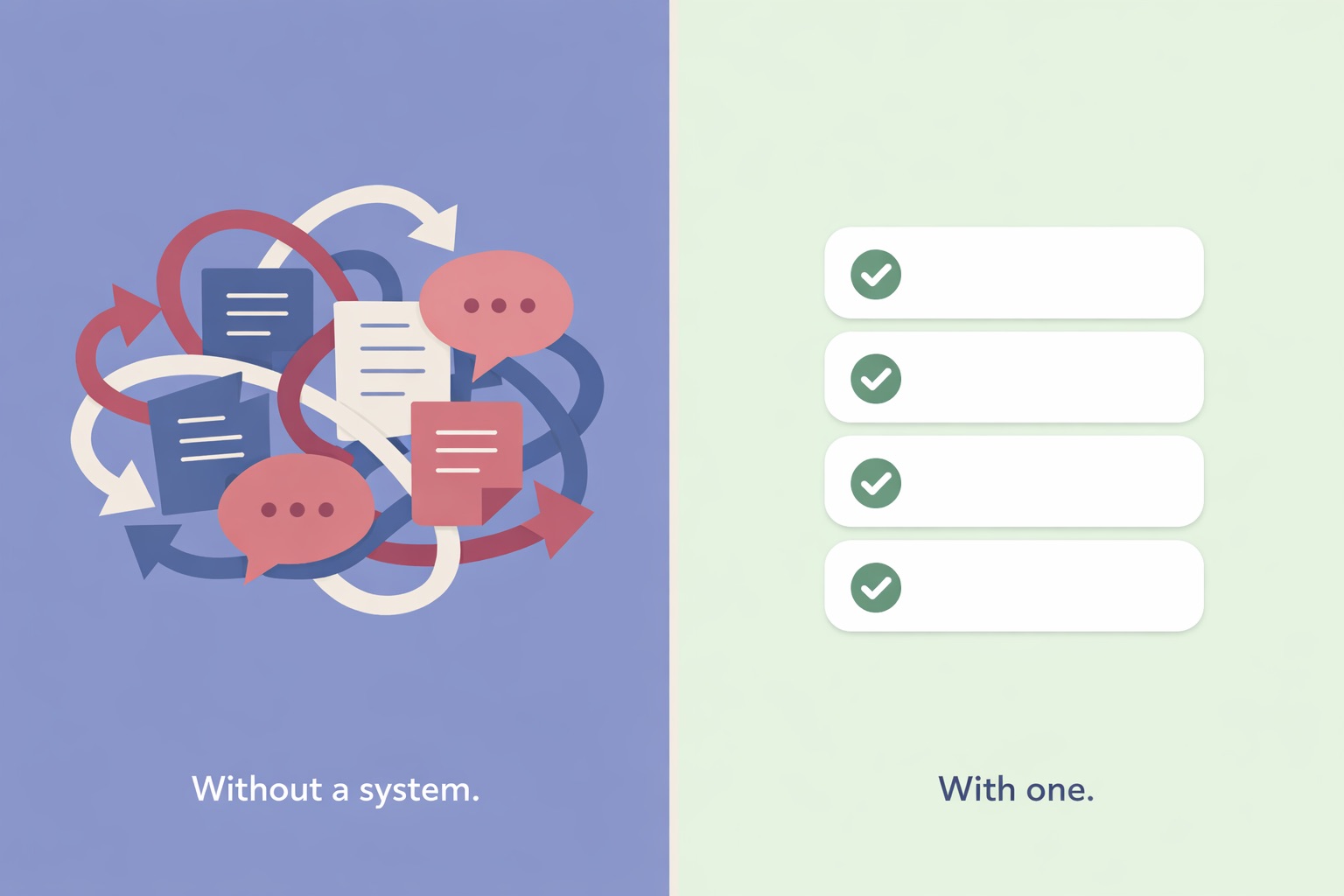
TL;DR: Saying no is not rejection - it is professional precision. The freelancers who protect their time, scope, and rates with clear, calm declines keep better clients longer, earn more, and avoid the burnout that comes from compounding yeses. This post gives you the frameworks and exact scripts to decline new projects, scope creep, rushed timelines, and rate pressure - without damaging the relationship.
The first time you say no to a client, your hands might shake a little. Maybe you stare at the draft email for twenty minutes before sending it. That is normal, and it is also a sign you've been operating without a system.
Most freelancers are not bad at saying no because they are pushovers. They are bad at it because they are working from instinct in high-stakes moments. They are calculating relationship risk in real time with no playbook.
This post gives you the playbook.
Why Freelancers Say Yes When They Mean No
Before the scripts, you need to understand the mechanics. There are five psychological traps that push freelancers toward yes.
1. Imposter syndrome
Research from the Journal of Behavioral Science found that 70% of people experience imposter syndrome at some point. Freelancers are especially vulnerable - no team, no manager, no colleague to sanity-check your decisions. When you do not feel fully secure in your rates or authority, saying no feels presumptuous. Like you haven't earned the right to refuse.
2. Feast-or-famine income anxiety
Irregular income creates scarcity thinking. Every yes feels like insurance against an empty pipeline. Every no feels like one step closer to a bad month. That fear is real, but it produces bad decisions - accepting projects that drain you, underpricing to secure work, tolerating scope creep rather than risking the relationship.
3. People-pleasing from employment
Many freelancers spent years in jobs where saying yes to managers was simply expected. The habit does not disappear when you go independent. Clients fill the authority vacuum. Saying no to a client feels the same as arguing with your old boss.
4. Confusing the request with the relationship
Saying no to a project is not the same as rejecting a person. Clients know this intellectually, but freelancers forget it emotionally. A professional "I can't take this on" almost never ends a relationship. A reluctant yes followed by poor delivery often does.
5. Sunk cost thinking
"I've worked with this client for eight months - I can't rock the boat now." This is how boundary violations compound. What started as occasional late-night messages or small out-of-scope requests slowly becomes the norm. The longer it goes on, the harder it feels to reset, and the more resentment builds underneath.
The Internal Checklist: Should You Say Yes or No?
Before responding to any client request, run five quick questions:
- Is this in scope? Does your contract or SOW explicitly cover it? If not, it needs a change order.
- Do I have real capacity? Can you deliver quality without harming other commitments?
- Does this pay fairly? Is the rate or budget aligned with the actual work?
- Would saying yes set a bad precedent? Will they expect this every time?
- Do I actually want to do this? Lack of interest has a cost, especially on long projects.
If two or more answers are no, decline or counter with revised terms. That's it. You don't need to agonize. The checklist removes the decision from your emotional state and puts it in logic.
The Four Situations That Require a No
There are four distinct situations where freelancers need to say no. Each has its own dynamic and its own best approach.
Situation 1: Declining a New Project
This is the clearest case - the project, client, or terms are not right, so you don't take it on.
Common reasons:
- Budget is below your rates
- The skills required don't match your expertise honestly
- Red flags in the initial conversation (pushing hard for discounts, dismissive about timelines, vague about what they actually want)
- You're fully booked and can't deliver quality work
- Long project with no genuine interest in the subject - low motivation affects quality over time
Framework: Three steps.
- Acknowledge the request and thank them genuinely.
- Decline in one clear sentence.
- Offer an alternative - a referral, a future start date, or a note to stay in touch.
Script - too busy:
"Thank you for reaching out - this project sounds like a good fit for what you're building. Unfortunately, I'm fully committed through [date] and wouldn't be able to give it the attention it deserves. I can add you to my list and reach out when a slot opens, or I'm happy to refer you to [name], who does excellent work in this area."
Script - budget mismatch:
"Thanks for sharing the details. My rate for this type of work is [X]. If the budget isn't flexible right now, I'd suggest reaching out to [referral]. I'd genuinely like to work together on something that fits both sides - feel free to circle back when you have a project with more room."
Script - skills mismatch:
"I appreciate you thinking of me. To be honest, this project is outside my core expertise, and I wouldn't want to take it on and not do it justice. [Name] specializes in exactly this - worth reaching out to them."
Situation 2: Declining Scope Creep Mid-Project
Scope creep is the most common and most damaging form of no-avoidance. It rarely arrives as a big ask. It shows up as "can you just add this feature?", "while you're in there, can you also fix...?", "this won't take you long, right?"
Each individual request seems too small to push back on. Collectively, they represent hours of unpaid work.
Framework: The Change Request Gate
Borrowed from software engineering project management. Every request that falls outside the agreed scope goes through a formal change order:
- Document the request.
- Estimate the real impact - hours, cost, and timeline shift.
- Present it as a change order: "Happy to add that - here's the change request with the estimate."
- Client approves or declines. No approval means no work starts.
This is not bureaucracy. It is the difference between a profitable project and one that quietly destroys your margin. Having a formal change request clause in your contract makes this even smoother.
Script - feature addition:
"Love that idea - [feature] would be a strong addition. That sits outside our current scope, so let me put together a quick change request with the cost and timeline impact. I'll send it over by [time]. If you approve, I'll slot it in right away."
Script - the "quick change" that isn't quick:
"Our current agreement covers [X]. What you're describing is actually closer to [Y hours of work] and isn't included. I'm happy to add it - here's a mini change order for [cost]. Alternatively, we keep the original scope and flag this for a future phase. Let me know which direction you want to go."
Situation 3: Declining a Timeline Compression
"We need this by Friday instead of next Wednesday." A rushed timeline either means cutting corners, pulling time from other clients, or burning out. None of those outcomes serve anyone.
Framework: The Tradeoff Reframe
Don't say "I can't do that." Make the real tradeoff explicit. When the client sees exactly what "yes" costs, they often self-correct.
"Delivering by Friday would mean pulling time from [other commitment]. I'm not willing to compromise quality on this - so the options are: keep the original timeline, or I can expedite it for a rush fee of [X%]. Which works better for you?"
This positions you as a professional managing real constraints, not someone being obstructive. It also gives the client agency. They're making the choice, not you.
Situation 4: Holding Your Rate Under Pressure
"Another freelancer quoted me half your price." "Can you do this for less?" "We're a startup - can we pay you more once we grow?"
Rate negotiation pressure is boundary testing dressed as financial constraint. How you respond determines how the rest of the engagement goes.
Script - direct hold:
"I understand budget is a constraint. My rates reflect the quality and consistency you're hiring for. I'm not able to go below [rate] for this scope. If the budget is fixed, I'm happy to look at reducing the scope to fit - let me know what you'd like to prioritize."
Script - reduce scope, not rate:
"I can't move on the rate, but I can adjust the scope. If we cut [X] and focus on [Y], I can bring it in at [lower total]. Want to map out what a smaller version of this looks like?"
Reducing scope while holding rate is a professional move. Reducing rate while holding scope is not.
Handling the Pushback
Clients sometimes push back on a no. Here is how to stay firm without escalating.
If they ask why:
Give one honest sentence. You don't owe a detailed defense. "My schedule is full through [date]" is a complete answer.
If they pressure you to reconsider:
Restate calmly. "I understand - I've thought it through, and my answer stands. I hope you find a great freelancer for this."
If they imply you're being difficult:
Stay neutral. "I'm not trying to be difficult - I'm just being honest about what I can commit to and still do a good job." Let that land. You don't need to elaborate.
If they threaten to take their business elsewhere:
"I understand. I hope things work out well." Then let them go. A client who uses future business as leverage to override your professional judgment is showing you exactly how the engagement will go.
Why Saying No Raises Your Value
This is the counterintuitive truth most freelancers discover the hard way: the more selectively you accept work, the more clients want to work with you.
When you decline work, you signal three things:
- You have a real workload - you're not desperate for any project at any price.
- You have standards - the work you do accept gets your full attention.
- You're honest - clients can trust what you say, including your estimates and commitments.
That combination builds a professional reputation faster than any amount of marketing.
One more thing: when you decline and refer someone else, that referral comes back. The freelancer you sent gets the work; they refer clients back to you. The client remembers you handled it graciously. You build goodwill in multiple directions by saying one respectful no.
Setting the Stage So You Say No Less Often
The best no is one you never have to say because the situation was never created. A few upstream habits dramatically reduce how often you're in a defensive position:
Scope documents with zero ambiguity. If it's not listed, it's not included. State this explicitly in every contract.
A formal change request clause. Clients know in advance that additions outside scope go through an estimate process. No surprises, no awkwardness.
Clear communication norms upfront. State your working hours, response times, and preferred channels in your onboarding process, before any friction arises.
Deposit requirements. Upfront deposits filter out unserious clients before a project begins. Clients who push back on a reasonable deposit are showing you their approach to professional agreements.
Track your time. Knowing exactly how long a project has taken gives you real data when a client asks for "just one more thing." You can point to hours, not feelings.
Frequently Asked Questions
ttime
Your work tracks itself. You track the revenue.
Tools
Pomodoro TimerAmbient NoiseTime Card GeneratorMeeting Cost CalculatorProject Cost Estimate CalculatorWorking Days CalculatorFreelance Job FinderBlog
Latest ArticlesThe Freelancer's Guide to Retirement PlanningHow to Say No to Client Requests Without Burning BridgesHow to Negotiate a Rate Increase With Existing ClientsHow to Fire a Bad Client Professionally (And Walk Away Clean)Freelance Contracts 101: Clauses You Should Never Skip© 2026 ttime. All rights reserved.
Built with ♥ for freelancers, by freelancers.