How to Negotiate a Rate Increase With Existing Clients
A practical framework for raising your freelance rates with current clients, including timing signals, email scripts, and how to handle every type of pushback.
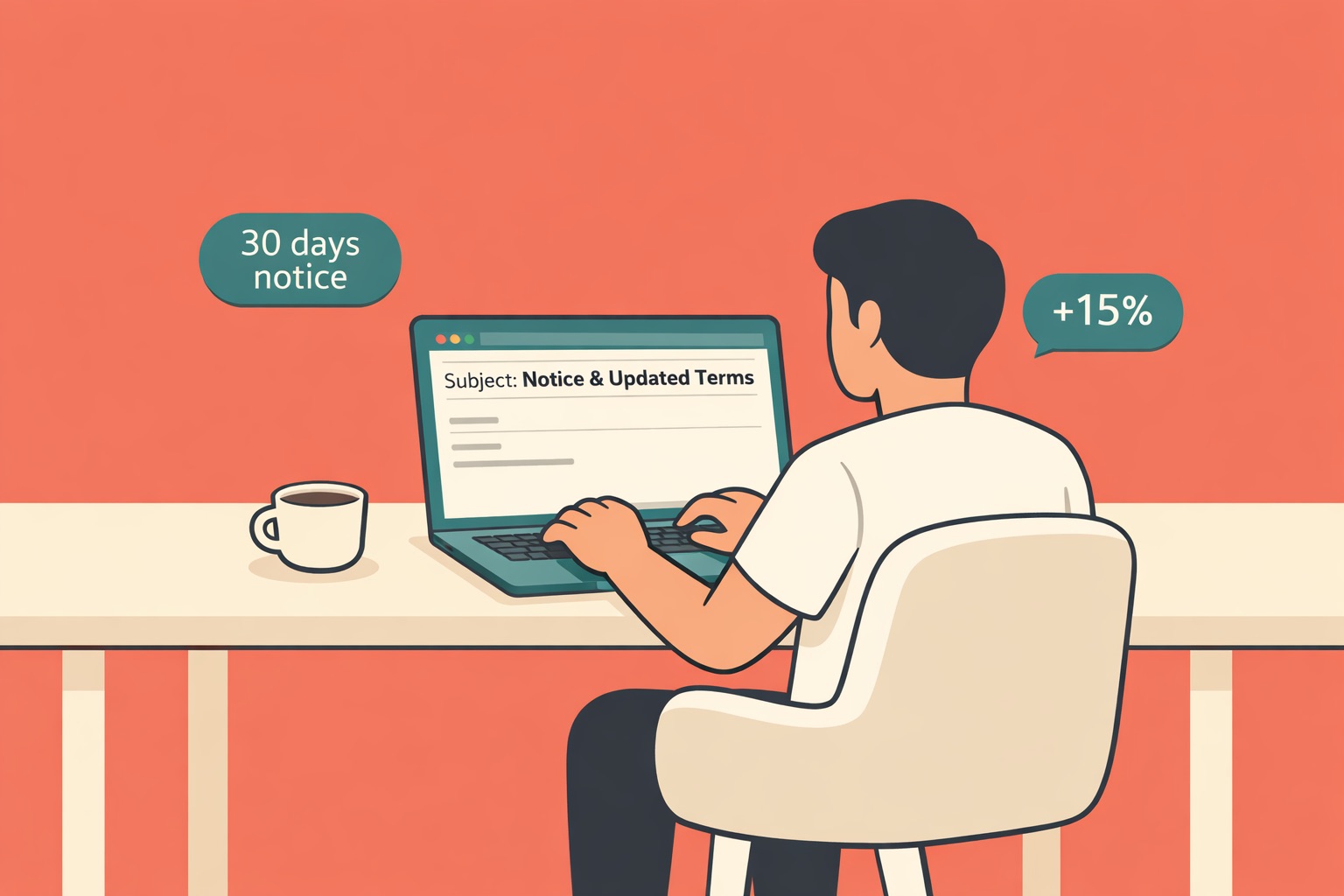
TL;DR: Raising your rates with existing clients comes down to three things: timing it right, framing it as a business update rather than a personal ask, and having a word-for-word script ready. The sweet spot is a 10-20% increase, delivered with 30-60 days notice, at a natural transition point - after a win, at contract renewal, or when scope has grown. If you track your time, you already have the data to make an unanswerable case.
Most freelancers know they should raise their rates. Most don't.
Not because the market won't support it. Not because their clients would refuse. But because the conversation feels personal in a way that a cold pitch to a new client doesn't. You've built something with this client. You know their business, their preferences, their quirks. Raising your rate feels like you're putting a price tag on that relationship.
Here's the reframe: your client isn't thinking about the relationship. They're thinking about the outcome they get from working with you. If that outcome is valuable, and if you've delivered consistently, a professional rate adjustment is something they've probably been expecting.
The average freelancer charges $20-$50/hr. The top 20% earns $80-$200/hr. The gap is rarely skill. It's almost always pricing confidence. This post gives you the framework, the math, and the exact scripts to close that gap with the clients you already have.
First: Check Whether It's Actually Time to Raise
Not every month is the right moment. Before you send anything, run through this checklist.
Strong signals - any one of these is enough:
- You haven't raised rates in 12 months or more
- You're booked at 80%+ capacity for four or more consecutive weeks
- You've had to turn down qualified work in the last 60 days
- A comparable peer quotes higher for equivalent work
- Your scope with this client has grown materially beyond the original agreement
- You've added skills, tooling, or specializations that deliver more value
Market context you should factor in:
- US CPI averaged ~3.4% in 2023 and ~2.9% in 2024. If you haven't raised rates in two years, you've taken a 6-7% real pay cut in purchasing power alone.
- The 2025 YunoJuno Freelancer Rates Report (62,000+ bookings) found average day rates rose 3% YoY; top-percentile rates rose 9%.
If you're checking two or more boxes on that list, it's time.
When not to do it:
- Immediately after a missed deadline or a rough delivery
- During an active project crisis on the client's side
- With no notice, mid-project, and no natural milestone in sight
Timing matters. A rate conversation after a successful launch lands completely differently than the same conversation during a fire drill.
How Much to Raise
The answer depends on how long you've held the same rate and what's changed in your business.
| Situation | Recommended Increase | |-----------|----------------------| | Annual adjustment, relationship stable | 5-10% | | 12+ months since last increase, skills have grown | 10-20% | | Scope has expanded significantly, or market repositioning | 20-30% | | Complete niche shift, major new capabilities | 30%+ (requires a direct conversation, not just an email) |
The consensus safe range for existing clients is 10-20%. Below 10% can feel like a non-event (you'll need to do it again soon). Above 30% in one go risks a difficult conversation about whether the relationship still makes sense.
One practical check: calculate your true hourly equivalent. Include non-billable hours - client calls, revisions, context-switching, invoicing. Freelancers who do this calculation consistently find they need to raise rates 15-30% just to maintain the same effective hourly rate they started with, because overhead has quietly accumulated.
The Right Framing (This Is the Hard Part)
The framing determines whether the conversation feels like a business update or an awkward ask.
Wrong framing:
- "My costs have gone up."
- "I need more money."
- "I've been doing this for a while and I feel like I should be earning more."
These put you in a dependent position. They make the rate increase about your needs, not their value. Clients are not your employer. They don't grant raises.
Right framing:
- "My rates are adjusting to reflect where my practice is and the value I'm delivering."
- "I'm doing a rate review across my client work - here's what changes."
- "This aligns my pricing with current market positioning."
The difference is agency. You're not asking for permission. You're informing a business partner of a change, professionally, with notice, and with respect for the relationship.
Two things to lead with before announcing the number:
- A genuine, specific acknowledgment of the work you've done together. Not flattery - a reference to a concrete outcome, a project that went well, or something you solved together.
- Market context if you have it. Inflation, industry rate data, or your own skill development. This frames the increase as a logical business update, not a personal request.
Use Your Time Data as Evidence
This is the angle most freelancers miss entirely.
If you track your time, you're sitting on a quiet superpower for rate negotiations: factual, unemotional evidence of how the engagement has actually evolved.
Scope drift is the most common. An engagement that started at 10 hrs/month and has quietly grown to 18 hrs/month - at the same retainer price - has effectively cut your hourly rate in half. You can see this in your time logs. Your client cannot.
A simple sentence - "Looking back at my time logs, this engagement has grown about 60% in scope over the last year. I'd like to align the rate with where we actually are" - is factual, non-confrontational, and very hard to argue with.
Other things your time data can show:
- Deliverable volume over time (more outputs per month than originally scoped)
- Non-billable overhead that has grown (extra review rounds, additional stakeholders)
- Your output speed - you complete the same work faster now, which means more value per hour
You don't need to present a spreadsheet. One or two concrete data points, casually referenced, shift the conversation from emotional to rational. That's where you want it.
Scripts That Work
Email: Standard annual rate increase
Use this for a healthy, established client relationship where scope has been roughly stable.
Subject: Rate update starting [Month Year]
Hi [Name],
I wanted to send you a note before the new [quarter/year/cycle] - I'm doing a rate review across my client work.
Starting [date - 4-8 weeks out], my rate will move from [current] to [new rate]. This puts me in line with current market positioning and reflects the kind of work we've been doing together.
I'm happy to lock in the current rate for any additional scope or projects confirmed before [date].
Let me know if you'd like to hop on a quick call.
[Your name]
What makes this work:
- Direct and short - doesn't over-explain or justify excessively
- Gives the client something concrete (lock-in option at old rate)
- Ends with an invitation to talk, not a request for approval
Email: Scope creep framing
Use this when the volume of work has grown well beyond the original agreement.
Subject: Scope and rate - quick note before next cycle
Hi [Name],
Before we kick off the next [month/sprint/cycle], I wanted to flag something.
Looking back at my time logs, our engagement has grown quite a bit from where we started - I've been averaging around [X hrs/month] over the last [period], up from the original [Y hrs/month].
I'd like to bring the pricing in line with the actual scope. Going forward, I'd like to move to [new rate or new monthly total], which reflects what we're actually doing together.
Happy to get on a call to talk through scope and make sure we're aligned before the next cycle starts.
[Your name]
What makes this work:
- References concrete time data without being confrontational
- Frames it as alignment, not a demand
- Offers a call to sort out scope - keeps the client involved
The opening line for a live conversation
If you prefer to have the conversation on a call before sending anything:
"Before we get into the project update, I wanted to spend five minutes on something on my end. I'm adjusting my rates starting [date], and I wanted to tell you directly. I'm happy to walk you through what the new structure looks like."
This signals respect for the relationship (you told them personally), takes the mystery out of it, and transitions cleanly to the project conversation.
Handling the Pushback
Not every client accepts immediately. Most will, but some will push back. Here's how to handle each scenario without caving on your rate.
"That's more than we budgeted."
Do not lower the rate. Offer to lower the scope.
"I understand. Let's look at what's in scope and see if we can right-size the engagement to fit your budget. If we reduce [specific deliverable], I can keep the total monthly cost closer to where it is now."
This keeps your rate intact. If they want the full scope, they pay the full rate. If they scale back, you've re-scoped rather than discounted.
"Can you hold the rate a bit longer?"
Set a specific date - don't leave it open-ended.
"I can lock in the current rate for work scoped before [date]. After that, the new rate applies. Does that work?"
Indefinite holds have a way of becoming permanent. Pin it to a date.
"Other freelancers charge less."
Don't panic, and don't match it.
"That may be true. I'm confident the new rate reflects the quality and turnaround you've come to expect. I'm happy to give you some time to think it over."
This is calm and non-defensive. It acknowledges the reality without conceding. Clients who use this objection are sometimes testing you.
"We've worked together a long time - I expected some loyalty here."
This one has an emotional charge. Acknowledge the relationship, then redirect.
"I really value what we've built - which is exactly why I'm giving you plenty of notice and telling you directly. I want this to keep working, and that means keeping the rate sustainable on my end. I think [new rate] is where that is."
When They Say No Outright
If a client declines a 10-20% increase and won't negotiate on scope either, you have three choices:
- Hold the rate for a defined period (one more contract cycle) then revisit. Don't hold it indefinitely.
- Offer a phased increase. "How about half now, and the other half in six months?"
- Begin winding down the relationship. A client who blocks every rate increase is capping your earning potential indefinitely. That work could go to a higher-value client.
A client who leaves over a well-communicated, reasonable rate increase was almost certainly going to be a problem client eventually. Good clients don't bail over 10-15%.
What to Do After the Increase Is Accepted
- Update your contract immediately with the new rate.
- Note the date in your invoicing system.
- Put a reminder in your calendar for 12 months out to review rates again.
If you track time, tag the first month at the new rate. It's a useful reference point when the next rate review comes around.
How Often Should You Raise Rates?
Once per year is the minimum. Annual reviews are expected in most professional service relationships - it's what happens with salaried employees, software subscriptions, and every other service your clients pay for. The freelancers who never raise rates often look like they're stagnating, not loyal.
A useful structure:
- Q4: Review all client rates. Identify which are below market.
- November-December: Send notices for changes effective January.
- January: New rates take effect.
This aligns with client budget cycles and feels completely normal.
Frequently Asked Questions
ttime
Your work tracks itself. You track the revenue.
Tools
Pomodoro TimerAmbient NoiseTime Card GeneratorMeeting Cost CalculatorProject Cost Estimate CalculatorWorking Days CalculatorFreelance Job FinderBlog
Latest ArticlesThe Freelancer's Guide to Retirement PlanningHow to Say No to Client Requests Without Burning BridgesHow to Negotiate a Rate Increase With Existing ClientsHow to Fire a Bad Client Professionally (And Walk Away Clean)Freelance Contracts 101: Clauses You Should Never Skip© 2026 ttime. All rights reserved.
Built with ♥ for freelancers, by freelancers.