What Is Freelance Work? Definition, Types & How to Start (2026)
Freelance work means working for yourself as an independent contractor. Learn what freelancing is, the most common types of freelance jobs, how much freelancers earn, and how to get started.
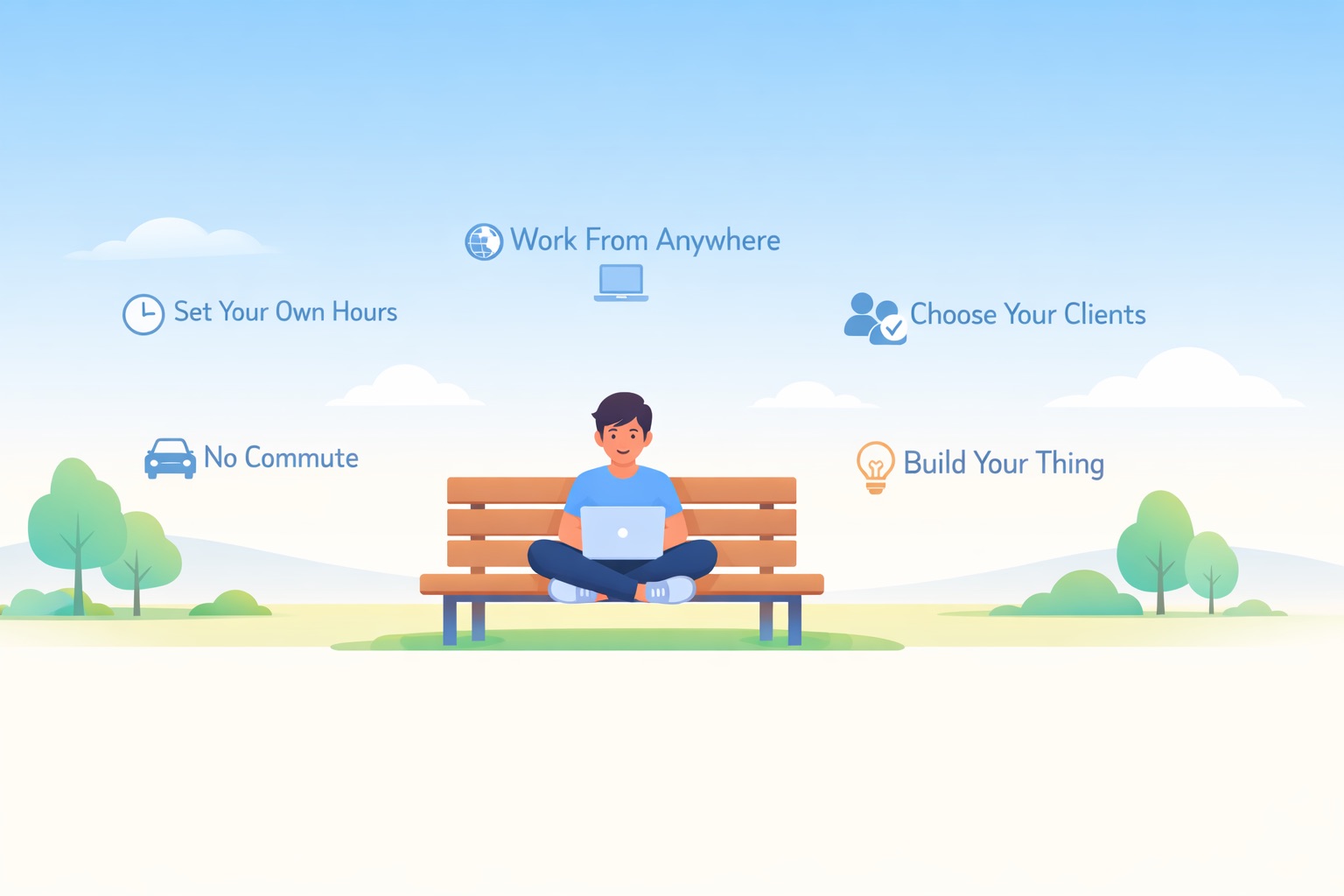
TL;DR: Freelance work means working for yourself as an independent contractor, offering services to clients on a per-project or contract basis. You set your own rates, choose your clients, and manage your own schedule. With over 73 million freelancers in the US alone, it's a legitimate and growing way to earn a living across fields like writing, design, development, marketing, and consulting.
Freelance Work, Defined Simply
Freelance work is when you sell your skills and services directly to clients without being a permanent employee. Instead of getting a salary and benefits from one employer, you work on projects for multiple clients, send invoices, and handle your own taxes.
Think of it this way: a staff graphic designer works 9-to-5 for one company. A freelance graphic designer might create a logo for a startup on Monday, design social media graphics for a restaurant on Wednesday, and build a brand guide for a coach on Friday. Same skills, completely different work structure.
Legally, freelancers are classified as independent contractors (1099 workers in the US), not W-2 employees. That distinction matters for taxes, benefits, and how you run your day-to-day.
And this isn't some niche career path. According to Statista, over 73.3 million people freelanced in the US in 2023, contributing roughly $1.27 trillion to the economy according to Upwork's Freelance Forward report.
How Does Freelancing Actually Work?
The basic freelancing cycle looks like this:
- Find a client who needs a specific service
- Agree on scope, timeline, and price (usually via a proposal or contract)
- Do the work on your own schedule, from wherever you want
- Deliver the finished project and get paid
That's the simplified version. In practice, freelancers spend time on marketing themselves, writing proposals, managing client communication, tracking finances, and continuously improving their skills.
Most freelancers find work through a mix of channels. Some use platforms like Upwork and Fiverr. Others rely on LinkedIn outreach, word-of-mouth referrals, or their own website and portfolio. Many successful freelancers combine several of these approaches. If you're curious about making platforms work for you, check out our tips for getting started on Upwork and Fiverr.
You can freelance as your full-time career or as a side hustle alongside a regular job. There's no single "right" way to do it, which is part of the appeal.
Common Types of Freelance Work
Freelancing spans nearly every industry, but some fields are especially popular:
- Writing and content creation - blog posts, copywriting, technical writing, ghostwriting
- Design - graphic design, UI/UX, illustration, brand identity
- Web and app development - front-end, back-end, WordPress, Shopify
- Marketing - social media management, SEO, email marketing, paid ads
- Virtual assistance - inbox management, scheduling, data entry, customer support
- Consulting - business strategy, HR, finance, operations
- Video and audio - video editing, animation, podcast production, voiceover
- Translation and transcription
The freelance platform market is growing at a 15.3% compound annual growth rate through 2030, according to Grand View Research, which means demand for freelance talent isn't slowing down. And 51% of Gen Z post-secondary workers freelanced in 2023, making it the fastest-growing demographic in the space.
Not sure which direction fits your skills? Our freelance job finder can help you match your experience to in-demand categories.
Freelance vs. Full-Time Employment: Key Differences
Here's a quick comparison to make the differences concrete:
| | Freelancer | Employee | |---|---|---| | Income | Variable, project-based | Steady paycheck | | Schedule | You decide | Set by employer | | Clients/Boss | Multiple clients | One employer | | Benefits | You provide your own | Health insurance, 401k, PTO | | Taxes | Self-employment tax (~15.3%), filed quarterly | Withheld by employer | | Location | Usually remote/flexible | Often office-based | | Job security | Depends on your pipeline | More stable (but not guaranteed) |
Neither option is universally "better." Freelancing offers freedom and earning potential, while employment offers stability and benefits. Many people start freelancing on the side before making a full transition, which is a smart way to test the waters. If that sounds like you, here's a step-by-step guide to freelancing while keeping your 9-to-5.
How Much Do Freelancers Make?
This is the question everyone wants answered, and the honest answer is: it varies wildly.
According to Payoneer's 2023 report, the median freelancer rate globally is about $28 per hour. But that number hides a huge range. Entry-level virtual assistants might charge $15-20/hr, while experienced developers or consultants regularly charge $100-250+ per hour.
A few things that influence freelance income:
- Your niche - technical and specialized skills command higher rates
- Your experience level - beginners earn less, but rates climb fast with a solid portfolio
- Your client base - working with businesses typically pays more than individual clients
- Your location - though remote work is closing this gap
Here's an encouraging stat: 36% of freelancers report earning more than their previous traditional job within two years. The key is choosing a skill area with strong demand, building a reputation, and raising your rates as you grow.
How to Start Freelancing
If you're thinking about giving freelancing a try, here's a practical path forward.
Pick Your Niche
Cross-reference what you're good at (or willing to learn) with what's actually in demand. Search your skill on Upwork and filter by jobs posted in the last 30 days. If you see 500+ listings, that's a healthy market. Google Trends can also show you whether interest in a service is growing or shrinking.
Set Up the Business Basics
You don't need to overthink this part. Here's what to tackle in a weekend:
- Register as a sole proprietor (free or under $50 in most states). If you expect to earn $50K+, consider forming an LLC.
- Get a free EIN from IRS.gov (takes about five minutes)
- Open a separate bank account for your freelance income
- Set up invoicing with a free tool like Wave
- Build a simple portfolio site with three work samples
Land Your First Clients
For platform-based work, create optimized profiles on Upwork and Fiverr. Send 3-5 personalized proposals per day on Upwork. Expect roughly a 10-15% response rate, so persistence matters.
For direct outreach, identify 20 small businesses on LinkedIn that could use your service. Send personalized messages offering genuine value, like a quick audit or specific suggestion for improvement.
A smart pricing strategy when starting out: set your rates 20-30% below the market average to build reviews and testimonials quickly, then raise them.
Manage Your Money From Day One
This is where many new freelancers stumble. Set aside 25-30% of every payment in a separate savings account for taxes. You'll owe self-employment tax (about 15.3%) plus income tax, and the IRS expects quarterly estimated payments.
Track all business expenses from the start. Your home office, software subscriptions, internet bill, and professional development costs can all be deductible. The home office deduction alone can save you up to $1,500 per year ($5 per square foot).
Freelancing isn't for everyone, but for people who want more control over their work, their time, and their income, it's one of the most accessible paths available today. The barrier to entry is low, the demand is real, and the tools to get started are mostly free. The hardest part is simply beginning.
ttime
Your work tracks itself. You track the revenue.
Tools
Pomodoro TimerAmbient NoiseTime Card GeneratorMeeting Cost CalculatorProject Cost Estimate CalculatorWorking Days CalculatorFreelance Job FinderBlog
Latest ArticlesThe Freelancer's Guide to Retirement PlanningHow to Say No to Client Requests Without Burning BridgesHow to Negotiate a Rate Increase With Existing ClientsHow to Fire a Bad Client Professionally (And Walk Away Clean)Freelance Contracts 101: Clauses You Should Never Skip© 2026 ttime. All rights reserved.
Built with ♥ for freelancers, by freelancers.