Is Fiverr and Upwork Still Worth It in 2026? An Honest, Data-Backed Answer
Fiverr's active buyers dropped 26% since 2022 and Upwork's fees keep climbing. Here's what the latest data says about who still wins on these platforms and when it's time to move on.
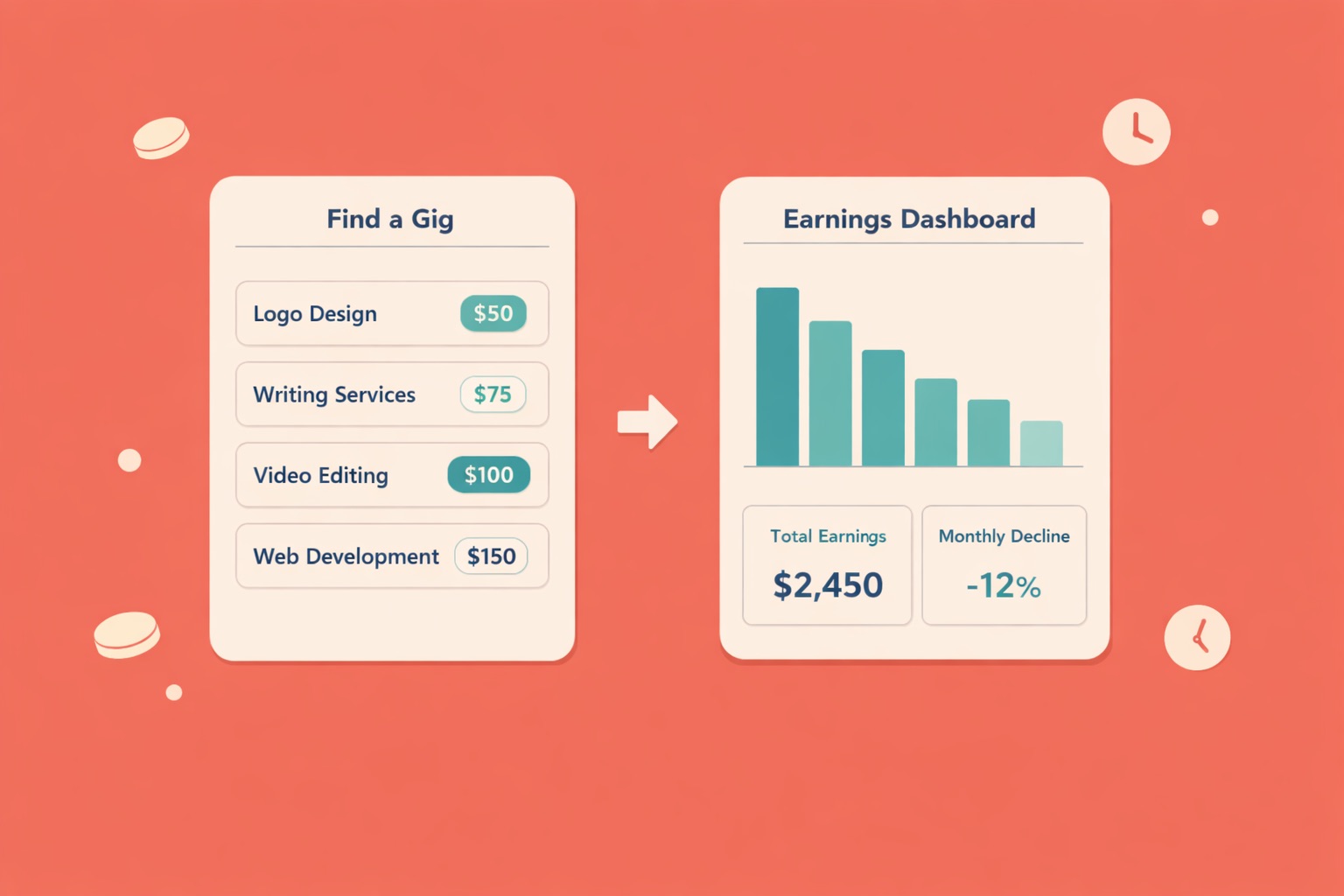
TL;DR: Both platforms are still alive - but for a much narrower slice of freelancers than three years ago. Fiverr has lost 26% of its active buyers since 2022, laid off 25% of its staff, and its core marketplace is shrinking. Upwork is more stable but increasingly enterprise-focused, fee-hostile to new entrants, and flooded with AI-generated proposals. Niche specialists with track records can still do well. Generalists and newcomers face a structurally worse deal than they did in 2022. And almost nobody - on either platform - knows their true effective hourly rate after fees, revisions, and unpaid overhead. That number is what should actually drive the decision.
The Numbers Most Reviews Won't Tell You
Most "Is Fiverr/Upwork still worth it?" articles are written from gut feeling and personal anecdotes. Let's start with what the investor reports actually say.
Fiverr: a marketplace in decline
Fiverr's annual active buyers peaked at 4.2 million in 2022. By the end of 2025 that number was 3.1 million - a 26% drop over three years, including a loss of approximately 500,000 buyers in 2025 alone.
At the same time, Fiverr's core marketplace revenue declined 2%. The company's stock fell more than 35% in 2025, leaving it valued at roughly $445 million - barely above its cash holdings and 31.5% below its 2019 IPO price. In mid-2025, Fiverr cut approximately 250 employees (about 25% of its workforce) and explicitly declared itself an "AI-first company." For 2026, the company is guiding for a revenue decline of 3-12%.
That's not a platform on a temporary dip. That's structural contraction.
The one bright spot: Fiverr's Services segment - Fiverr Pro and Managed Services - grew 83.8% to $33.9 million. The premium, enterprise-adjacent part of Fiverr is growing. The mass-market gig marketplace is shrinking. Those are two very different products for two very different kinds of freelancers.
Upwork: stable, but not what it was
Upwork tells a more nuanced story. Full-year 2025 revenue grew 2% to $787.8 million and free cash flow reached $223.1 million. The platform isn't in crisis.
But active clients fell from roughly 855,000 in Q3 2024 to 785,000 by the end of 2025. Revenue is growing while the client pool shrinks - which means the buyers who remain are spending more. The platform is consolidating around higher-value engagements, and it's reorganizing to serve them: in July 2025, Upwork's AI assistant Uma evolved into a full AI Work Agent that now conducts client job interviews, generates job posts, and reviews proposals. A majority of new client job posts on Upwork are now AI-generated.
For context on competition: jobs that once attracted 20-30 proposals now routinely receive 80-150, many of them AI-generated. The cold-start problem for new freelancers - always hard - has become dramatically worse.
The Fee Math Nobody Does
Every article mentions the fees. Almost none of them do the actual math on what fees cost you.
Fiverr charges a flat 20% on every transaction, regardless of order size or tenure. Upwork moved to a dynamic 0-15% model in May 2025, though in practice no freelancer has reported seeing below 10%, and many see 15% on new contracts. The fee isn't shown until you submit a proposal - you can't model it in advance.
Here's what that means in practice. Take a fixed-price project priced at $500 on Fiverr:
- You receive: $400 (after 20% cut)
- Estimated time: 8 hours → $50/hr effective rate
- Actual time (with one round of revisions not in scope): 13 hours → $30/hr effective rate
- Add 2 hours of proposals, messages, and back-and-forth before the contract started: 15 hours total → $26/hr effective rate
That's a plausible scenario for a mid-range freelancer in a competitive category. If you're based in a Western country with real costs of living, that number is painful.
The point isn't that every project plays out this way. The point is that most freelancers on these platforms have never done this calculation for their actual numbers. They feel good or bad about a platform based on gross revenue, not net-per-hour. That gut feeling can be significantly wrong in either direction.
The only way to know your real position is to track it: time logged, fees paid, revision hours, and proposal time. Without that data, you're flying blind on one of the most important business decisions you'll make as a freelancer.
What Freelancers Are Actually Saying
The divide in freelancer sentiment maps almost exactly onto niche depth and experience level.
Established niche specialists are mostly holding on. One seller with $2.4 million in career earnings on Fiverr is still active - but he's shifted his entire acquisition strategy to YouTube and LinkedIn, driving his own traffic to his Fiverr profile rather than relying on internal search. He uses Fiverr as a trust layer and payment processor, not as a discovery engine. That's a fundamentally different business model than what most freelancers think they're signing up for.
Mid-range generalists are increasingly frustrated. The pattern: gig traffic was steady, then an algorithm update hit, visibility dropped, and it never fully recovered. One seller described watching their Fiverr income fall from 50% of total revenue to 15% over 18 months - not because their work got worse, but because "the traffic just isn't there anymore."
New and early-career freelancers are the most disillusioned. Spending Connects budget on Upwork with zero responses. Accounts suspended with no warning and no meaningful appeal process. Fixed-price projects underscoped by clients who know they can request revisions for free. Pricing wars with freelancers from lower-cost countries. Multiple widely-read pieces from 2024 and 2025 - with titles like "Goodbye Upwork" and "Why I'm Quitting Fiverr and Upwork" - drew substantial readership, a rough proxy for the size of the latent frustration.
There's a legitimate counterpoint: for niche specialists who can avoid the commodity pricing trap, the platforms still deliver real volume that's hard to replicate through direct outreach alone. The marketplace model works - just for fewer people than it used to.
Who Still Succeeds and Why
The structural reason niche specialists outperform on both platforms comes down to search density. When a buyer searches for a "Webflow developer for B2B SaaS landing pages," the results are shorter and less competitive than for "web developer." Specialists face less competition, command higher prices, and the two effects compound.
Fiverr's own data confirms the bifurcation: spend per buyer grew 13.3% year-over-year to $342, and GMV from transactions over $1,000 grew 22.8%. The buyers who remain are spending more on each engagement. That benefits specialists who can justify higher prices - not commodities competing on $5 gigs. For a deeper look at which highest-paying freelance specializations are pulling ahead, the data paints a clear picture.
Freelancers who are succeeding in 2026 tend to fall into these categories:
- Developers with specific stack depth - Webflow, Shopify custom builds, specific API integrations, AI agent workflows, Make.com automation
- Video specialists with repeatable formats - product explainers, YouTube intros, real estate walkthroughs - where scope is predictable and revision risk is low
- AI-skilled freelancers - Fiverr data shows searches for AI agent expertise up 18,347% over six months; demand for AI video creators up 66% year-over-year
- Established sellers with 100+ reviews - the algorithm actively rewards consistent activity and high Job Success Scores; existing reputation compounds over time
- Fiverr Pro and enterprise-channel sellers - who access the Managed Services segment rather than the open marketplace
The common thread isn't a platform - it's a position. Specialists who can't easily be replaced by the next lower-priced profile, and who have enough review history that the algorithm sends them traffic regardless of what new entrants do.
Who Should Leave - and What to Do Instead
If you're in any of the following situations, the math has likely turned against you.
Generalists in commoditized categories. General copywriting, basic graphic design, generic web development, and data entry have all been heavily affected by AI tools that let buyers do the same work themselves - or hire an AI-assisted freelancer who undercuts on price. If your output looks like something a good AI prompt could produce, the platform will eventually match you against someone charging less.
Senior professionals with high rates. The fee structure erodes margins that are already thin at premium price points, and the open marketplace client caliber often doesn't match the expectations of a senior practitioner. A client who found you on Fiverr expecting a $150 deliverable behaves differently than one who sought you out directly.
Developers and designers in high-cost countries competing on price. Labor arbitrage is structurally unwinnable. This isn't a solvable positioning problem - it's an economics problem.
Anyone with low tolerance for platform risk. Sudden account suspension with no clear cause, gig delisting after algorithm updates, Connects spent on zero-response applications - these are real and documented risks the platforms don't protect you from. If your platform income is material to your finances, that dependency is fragile. If you're still actively applying, learning to write proposals that actually get read can at least improve your hit rate while you explore other channels.
What to do instead
The freelancers who have left these platforms most successfully share a pattern: they used the platforms to build a track record, then leveraged that track record to exit.
- LinkedIn direct outreach - particularly effective for B2B-adjacent services (tech, marketing, operations). The client quality and rate tolerance are higher than the open marketplace.
- Content-led inbound - publishing on Substack, Dev.to, or Medium builds authority that attracts direct inquiries. Takes time; has no platform fee when it works.
- Contra or PeoplePerHour as transitional platforms - Contra charges 0% to freelancers and grew 20% in Q1 2025. PeoplePerHour's fee drops to 3.5% on larger projects. Neither has Fiverr's traffic, but neither takes 20% of every dollar.
- Productized services on your own site - define a specific deliverable with fixed scope, post it on your site, accept payment via Stripe. Same gig model, 0% platform fee.
- Niche communities - Slack groups, Discord servers, GitHub sponsorships, and niche job boards (We Work Remotely, Lemon.io for developers) often yield higher-quality leads than general marketplaces. You can also use a freelance job finder to browse curated listings across multiple boards in one place.
The Decision Framework
Before you make a call, answer these five questions:
1. Do you have a clearly defined niche that's hard to commodity-price? Yes → platforms can still work. No → solve your positioning problem before investing more in a marketplace.
2. Do you have an established track record on the platform (50+ reviews, consistent activity)? Yes → you have algorithmic momentum worth preserving. No → the cold-start cost in Connects, time, and low-rate early projects is much higher than it was in 2022.
3. What is your actual effective hourly rate after fees, revisions, and non-billable time? Don't know → calculate it before making any strategic decision. Gross revenue is not the same as net-per-hour.
4. Is your income from this platform replaceable if your account is suspended tomorrow? No → reduce the dependency before something forces you to.
5. Are you spending more time on the platform's meta-game (proposals, algorithm optimization, Connects management) than on billable work? Yes → the overhead is already eating your effective rate. That time has a cost.
FAQ
Final Takeaway
The honest answer to "Is Fiverr and Upwork still worth it?" isn't yes or no. It's: worth it for whom, at what effective rate, and compared to what alternative?
The platforms are consolidating around specialists with track records. If that describes you, the shrinking buyer pool may actually help - less noise, higher spend per client. If it doesn't describe you yet, the path forward starts with specialization and tracking your real numbers, not with spending more Connects.
Either way, calculate your effective hourly rate. That single number will make the decision for you.
ttime
Your work tracks itself. You track the revenue.
Tools
Pomodoro TimerAmbient NoiseTime Card GeneratorMeeting Cost CalculatorProject Cost Estimate CalculatorWorking Days CalculatorFreelance Job FinderBlog
Latest ArticlesThe Freelancer's Guide to Retirement PlanningHow to Say No to Client Requests Without Burning BridgesHow to Negotiate a Rate Increase With Existing ClientsHow to Fire a Bad Client Professionally (And Walk Away Clean)Freelance Contracts 101: Clauses You Should Never Skip© 2026 ttime. All rights reserved.
Built with ♥ for freelancers, by freelancers.